

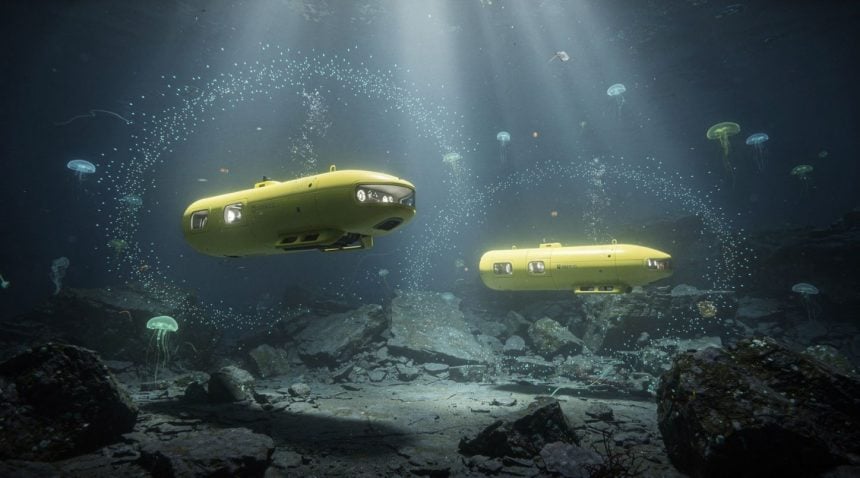
Two oblong neon submersibles began their descent nearly 6,000 meters into the Pacific Ocean last week, and by the end of May, they will have fundamentally altered what we know about the ocean floor—and who gets to explore it.
For decades, deep-sea exploration was the exclusive domain of well-funded research institutions and government agencies. The cost of building and operating submersibles capable of reaching the abyssal zone kept the frontier locked behind institutional gatekeeping. But the arrival of inexpensive seafloor-hopping submersibles marks a threshold moment: the democratization of the deep ocean is about to collide with commercial mining interests, scientific curiosity, and regulatory uncertainty in ways nobody is fully prepared for.
- The Cost Revolution: New submersibles cost a fraction of traditional million-dollar deep-sea vehicles, removing institutional barriers to ocean exploration.
- The Mining Connection: Cheap reconnaissance technology enables faster mapping of seabed mineral deposits essential for battery production and renewable energy infrastructure.
- The Regulatory Gap: International maritime law enforcement remains weak while commercial and scientific interests race to map and claim deep-sea resources.
The submersibles currently diving represent a technological inflection point. Their affordability—a dramatic departure from the million-dollar behemoths of previous decades—means that universities, private research teams, and commercial entities can now fund their own expeditions without waiting for grants or institutional approval. Throughout May, these vessels will conduct a series of dives that will generate data, imagery, and biological samples from depths that have remained largely unexplored by human technology.
Why Does Cheap Ocean Access Matter Now?
What makes this moment particularly charged is the timing. These dives arrive at a moment when deep-sea mining has moved from theoretical discussion to imminent industrial reality. The seabed contains polymetallic nodules rich in manganese, nickel, cobalt, and copper—elements essential for battery production and renewable energy infrastructure. As the world races to electrify transportation and power grids, the ocean floor has become an economic frontier. Cheap submersibles mean cheap reconnaissance. Cheap reconnaissance means faster mapping of mining sites. Faster mapping means faster extraction.
• Seabed mining could supply 25% of global battery mineral demand by 2035
• A single polymetallic nodule field can contain more cobalt than most land-based mines
• Traditional deep-sea research vessels cost $50,000+ per day to operate
The scientific community recognizes both the opportunity and the risk. These submersibles will enable researchers to catalog species, study hydrothermal vent ecosystems, and collect data on ocean chemistry and geology at scales previously impossible. The data generated could reshape our understanding of deep-sea biodiversity and the role of the abyssal zone in planetary systems. But the same technology that enables discovery also enables exploitation. A mining company with access to affordable submersibles can now map and assess seabed resources with minimal public oversight or scientific input.
Who Controls the Ocean Floor?
The regulatory landscape remains fragmented. International maritime law governs some aspects of ocean exploration, but enforcement is weak and jurisdiction is contested. The International Seabed Authority exists to manage mineral resources in international waters, but its authority is limited and its decision-making processes are notoriously slow. National governments claim territorial waters extending 200 nautical miles offshore, but enforcement varies wildly by region and economic capacity. Into this legal gray zone, inexpensive submersibles are now descending.
What happens in May matters because it will establish precedent. The data collected, the organisms discovered, the mineral deposits identified—all of it will be documented, published, and available. Once that information enters the scientific record, it becomes a resource that others can build upon, challenge, or exploit. The first comprehensive maps of a region’s mineral wealth, generated by these May dives, could become blueprints for future mining operations.
What This Means for Your Digital Life
For the average person scrolling through news on their phone, this might seem distant—another story about ocean exploration happening far away. But the minerals extracted from the seabed in the coming years will power the devices in your pocket and the data centers that store your information. The batteries in your electric vehicle, the lithium in your laptop, the cobalt in your phone charger—these will increasingly come from the ocean floor. How that extraction is managed, regulated, and studied will determine whether deep-sea ecosystems survive the process or become collateral damage in the race for renewable energy materials.
• Institutional gatekeeping previously limited deep-sea access to major research organizations and government agencies
• Cost barriers that once required million-dollar budgets have dropped to accessible levels for smaller entities
• This democratization occurs precisely as commercial mining interests intensify their focus on seabed resources
According to research from the Naval War College, the shift toward accessible deep-sea technology represents a fundamental change in who can conduct ocean exploration. The traditional model required institutional backing and government approval, creating natural checkpoints for environmental and scientific oversight. Now, the barriers to entry have collapsed just as the economic incentives for seabed exploitation have intensified.
The neon submersibles diving this month represent a technology inflection point, but they also represent a choice point. Will inexpensive deep-sea access be governed by scientific stewardship, commercial extraction, or some hybrid model that serves both? The data collected over the next few weeks will inform that answer, whether the people making those decisions realize it or not.