

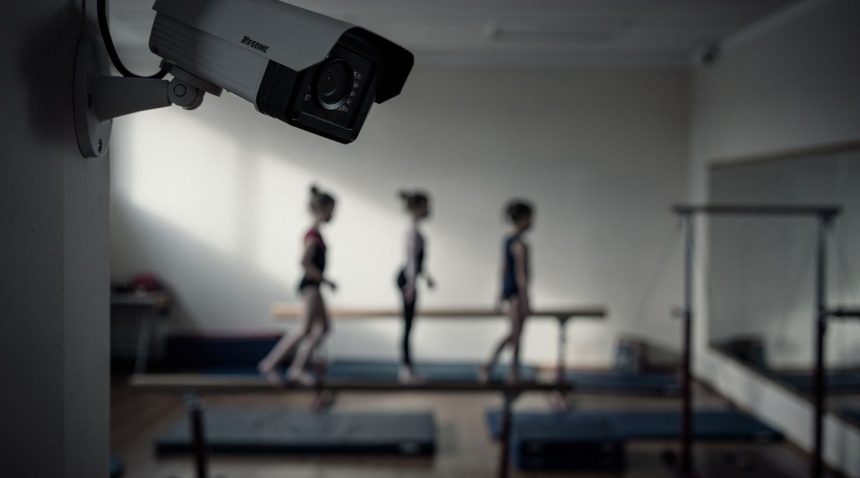
A surveillance camera company deployed its technology at a children’s gymnastics center to film young athletes without parental consent, using the footage as a sales demonstration to potential corporate clients.
The incident, involving Flock, a prominent provider of surveillance infrastructure, exposes a critical gap in how private surveillance systems operate in spaces where children gather. While the company frames its cameras as tools for law enforcement and public safety, this case reveals how the same technology can be activated in intimate private settings—and how easily consent requirements can be sidestepped when a business relationship exists between the camera operator and the facility owner.
- The Consent Gap: Flock recorded children at a gymnastics center and used the footage for corporate sales demonstrations without parental knowledge or permission.
- The Legal Loophole: Facility owner consent does not constitute parental consent for filming minors, yet surveillance companies operate in this gray area.
- The Expansion Pattern: Companies primarily serving law enforcement are testing surveillance capabilities in private spaces to pitch broader commercial applications.
According to reporting from 404 Media’s podcast investigation, Flock installed cameras at the gymnastics center and recorded footage of children during normal operations. The company then used that video as part of a sales pitch to demonstrate its capabilities to prospective clients. Parents who had enrolled their children in classes at the facility had no knowledge that their children were being filmed or that the footage would be repurposed for corporate marketing.
The gymnastics center itself appears to have authorized Flock’s presence and use of the footage, but there is no indication that parents received notice or gave explicit permission for their children to be recorded and shown in a sales demonstration. This distinction matters legally and ethically: consent from a facility owner does not automatically constitute consent from the individuals—especially minors—being filmed.
How Do Surveillance Companies Expand Beyond Law Enforcement?
Flock’s core business model centers on providing automated camera systems that capture license plate data and vehicle information, primarily marketed to law enforcement agencies. The company has expanded its reach significantly, with its cameras now deployed across hundreds of jurisdictions in the United States. The gymnastics center incident suggests the company is also exploring use cases beyond traditional law enforcement, testing how its surveillance infrastructure performs in new environments and pitching those capabilities to a broader range of potential buyers.
The use of children’s images in a corporate sales pitch raises particular concerns. Federal privacy laws like FERPA provide certain rights for parents regarding their children’s records, but video surveillance in physical spaces operates in a murkier legal territory. State and local privacy laws vary widely, and many jurisdictions lack explicit requirements that businesses obtain parental consent before recording minors in private facilities.
• Most states lack explicit parental consent requirements for surveillance in private facilities
• Federal privacy protections focus primarily on educational records and online data collection
• Facility owner consent often treated as sufficient authorization for recording all occupants
What Makes Private Space Surveillance Different?
What makes this case significant is not that Flock invented secret surveillance—it’s that the company normalized the practice within a trusted private space. Parents enrolling children in gymnastics classes reasonably expect a baseline of privacy and safety. They assume that if cameras are present, they will be informed. They do not expect their children to become unwitting subjects in corporate product demonstrations.
The incident also highlights how surveillance infrastructure, once installed, can be repurposed in ways that extend far beyond the original stated purpose. A camera system justified for security can become a marketing tool. Footage from one context can be extracted and repackaged for another. The person or entity controlling the cameras—in this case, Flock through its relationship with the facility—determines what happens to that data.
For parents, the gymnastics center case is a concrete example of how surveillance operates in blind spots. Most people understand that their phones track them, that social media platforms monitor their behavior, and that their cars transmit data. But surveillance technology in physical spaces—especially private businesses—often feels invisible and unregulated. A parent dropping off a child at a class does not expect to be part of a surveillance experiment or a sales pitch.
Where Does Surveillance Footage Go After Recording?
Flock has not publicly commented on the specific incident at the gymnastics center, and it remains unclear whether the company obtained any formal consent from the facility or notified parents after the fact. The 404 Media podcast investigation serves as the primary public documentation of what occurred.
• Research on surveillance ethics shows consent requirements vary dramatically across jurisdictions and facility types
• Private facilities often operate with minimal oversight compared to public space surveillance
• Children’s privacy protections focus heavily on digital platforms rather than physical surveillance
The broader question is whether current legal and regulatory frameworks can keep pace with how surveillance companies deploy and repurpose their technology. If a camera system can be installed, activated, and used for corporate purposes without explicit parental notice, what other private spaces might become testing grounds for surveillance infrastructure? And what happens to the footage once it leaves the facility where it was recorded?
As surveillance technology becomes cheaper and easier to deploy, the risk of normalization increases. Each incident where cameras operate without clear consent makes the next deployment slightly easier to justify. The gymnastics center case suggests that without stronger consent requirements and clearer restrictions on how footage can be used, private spaces will continue to become part of the broader surveillance ecosystem—often without anyone noticing.
This incident demonstrates how corporate data practices extend beyond digital platforms into physical spaces where families expect privacy and safety. The challenge for parents and policymakers is establishing clear boundaries before surveillance infrastructure becomes so normalized that consent becomes an afterthought rather than a requirement.