

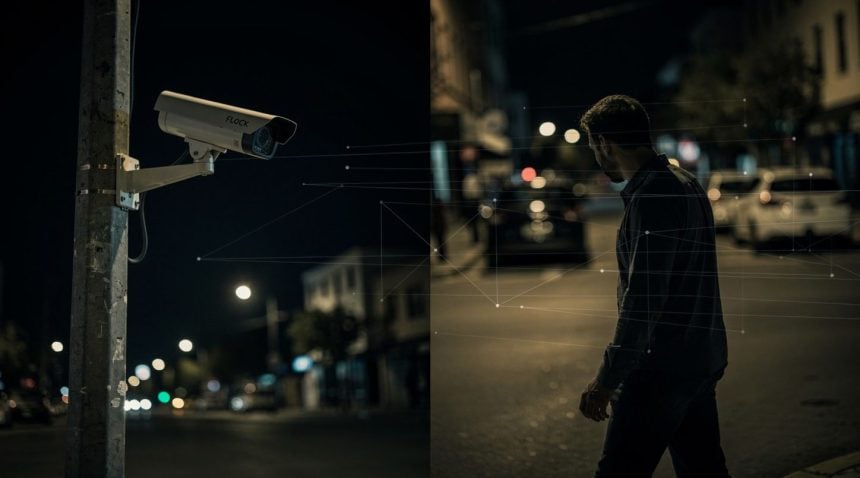
A police officer in one American city pulls up a real-time map of surveillance cameras, searches for a specific person’s license plate, and watches their movements across town—not as part of an active investigation, but to monitor an ex-partner or track someone they’ve developed an obsession with. Over a dozen documented cases across the country confirm this scenario is not hypothetical. It is a recurring pattern enabled by infrastructure that was designed for crime-fighting but deployed without the safeguards that power of that scale demands.
The vulnerability isn’t new technology or a software flaw. It’s institutional access to Flock’s mass surveillance camera network combined with minimal oversight of who uses it and why. Police officers with legitimate credentials have repeatedly abused the system for personal stalking, exposing a structural gap between the infrastructure’s intended use and its actual deployment in officers’ hands.
- Scale of the Problem: Over a dozen documented cases across multiple states show officers using Flock Safety’s network to stalk ex-partners and conduct unauthorized surveillance, resulting in criminal charges and terminations.
- The Access Gap: Flock’s system places no built-in requirement on officers to document search justifications, with no automated flagging when the same person is queried repeatedly outside an active case.
- The Design Failure: Flock’s terms of service and technical architecture assign responsibility for preventing misuse to individual police departments, not to the company that built and operates the network.
Flock Safety operates one of America’s largest networks of automated license plate readers (ALPRs) and surveillance cameras installed on private property—traffic poles, storefronts, parking lots—across thousands of jurisdictions. The system works by capturing vehicle images and plate numbers in real time, then making that data searchable to law enforcement agencies that subscribe to the service. An officer can query the system to locate a specific vehicle or person across the network’s coverage area within seconds. As the ACLU has documented, Flock’s expansion has moved well beyond simple plate reading, with the company now converting its readers into full surveillance cameras capable of far broader monitoring than originally marketed to departments or the public.
For context on how broadly this infrastructure has spread, the legal battle over DeFlock.me revealed just how extensively Flock’s cameras have been deployed across American communities—often without residents knowing the network exists at all.
How Does Flock’s Access Model Enable Insider Abuse?
The problem emerges at the point of access. Once a police department gains credentials to search Flock’s database, individual officers can conduct searches with minimal friction or audit trail. There is no built-in requirement to document why a search is being performed, no real-time supervisor approval gate, and no automated flagging system that alerts management when an officer searches for the same person repeatedly or outside the context of an active case.
The result: officers have used Flock to track ex-partners, monitor individuals they were personally interested in, and conduct surveillance that would be illegal if done manually but becomes nearly invisible when filtered through a commercial surveillance platform. The cases are documented in arrest records and disciplinary proceedings across multiple states, with officers facing stalking charges, termination, and criminal prosecution.
• Over a dozen criminal cases documented across multiple states involving officers misusing ALPR access for personal surveillance
• Flock Safety operates across thousands of law enforcement jurisdictions in the United States
• 375 warrantless searches were uncovered in Georgia alone in a single EFF investigation into Flock’s use for school residency checks
• Seven states have moved to restrict public transparency over ALPR data, limiting external accountability mechanisms
Why Does This Pattern Echo Cambridge Analytica?
This pattern mirrors a structural vulnerability that emerged during the Cambridge Analytica scandal. In that case, Facebook’s platform allowed third-party developers to access user data at scale with minimal oversight—not because the data was inherently exposed, but because the access controls were permissive and the audit mechanisms were weak. Developers could pull psychological profiles, behavioral data, and personal information on millions of users, then use it for purposes Facebook didn’t intend and users didn’t consent to. The legacy of Cambridge Analytica is precisely this lesson: powerful data infrastructure combined with legitimate institutional access and insufficient guardrails produces predictable, large-scale harm.
The bridge between Flock and Cambridge Analytica is structurally identical—powerful data infrastructure, legitimate institutional access, and insufficient guardrails against misuse by insiders. The difference is that Flock’s data is location and vehicle movement, arguably more immediately threatening than digital behavioral profiles. A psychological profile can influence how someone votes. A real-time location feed can tell a stalker exactly where their target is parked right now.
• The ACLU has consistently argued that surveillance systems deployed without robust use-restriction policies create conditions where abuse is not an anomaly but a predictable outcome of the design
• ACLU research on police surveillance technology documents how systems installed without independent oversight mechanisms disproportionately enable misuse against vulnerable populations
• The practical implication: when access controls are frictionless by design, the burden of preventing abuse falls entirely on individual officer conduct rather than on systemic safeguards—a model that has repeatedly failed
What Does Flock’s Business Model Prioritize?
Flock’s business model depends on police adoption. The company markets its system as a crime-fighting tool, and departments across the country have integrated it into their operations. But the company’s terms of service and technical architecture place the burden of preventing misuse on individual police departments, not on Flock itself. There is no built-in role-based access control that limits searches to authorized investigators on specific cases. There is no automated detection system that flags suspicious search patterns. There is no requirement for Flock to audit or report officer access to departments.
This is not a technical limitation—it is a product decision. The friction that would prevent a stalking officer from querying an ex-partner’s plate is the same friction that would slow down a legitimate investigator. Flock has chosen to minimize that friction to maximize adoption, and the documented cases of abuse are the direct consequence of that choice. The broader transparency problem compounds this: as seven states have now moved to block public access to police ALPR data, external accountability mechanisms are being dismantled at precisely the moment they are most needed.
Is the Average Driver Aware of This Exposure?
For the average driver, this means your vehicle’s movements are being continuously recorded by a network of cameras you likely don’t know exist, searchable by any police officer in a subscribing jurisdiction, with minimal oversight of whether that search is legitimate. If an officer with access to Flock develops a personal interest in you—romantic, obsessive, or retaliatory—they have a ready-made tool to track your location in real time, and the system provides almost no friction or detection mechanism to stop them.
The arrests and prosecutions of these officers are necessary accountability, but they’re also a symptom of a larger design failure. Flock has built a mass surveillance infrastructure and distributed it to thousands of police departments without implementing the technical and procedural safeguards that should accompany that power. Until those safeguards exist—mandatory case logging, automated flagging of repeated searches, real-time supervisor approval, and independent audits conducted by Flock rather than delegated entirely to departments—the system will remain vulnerable to the same insider abuse that has already produced over a dozen criminal cases.
The question now is whether Flock will implement these controls voluntarily, or whether it will take regulatory pressure or litigation to force the issue. Given the company’s incentive to keep police adoption frictionless, the answer may depend on how many more cases surface before the infrastructure is redesigned with accountability built in rather than bolted on afterward.