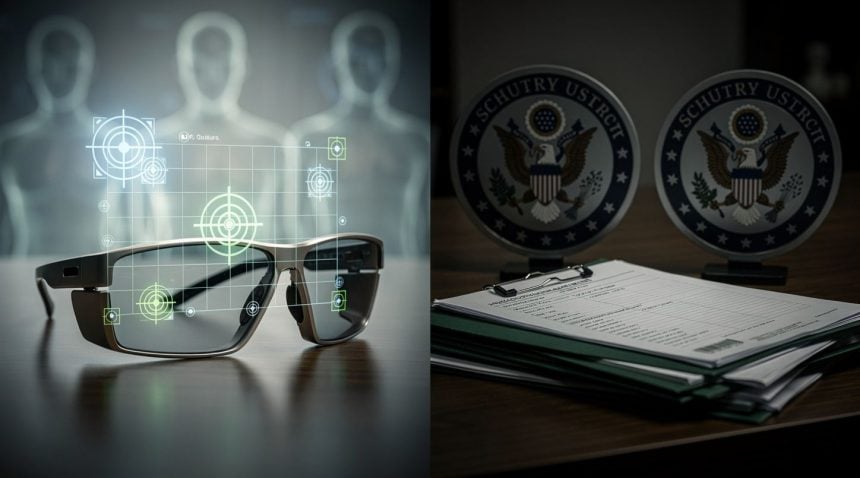
Immigration and Customs Enforcement is building its own facial recognition smart glasses—a move that sidesteps existing oversight mechanisms and signals a significant expansion of the agency’s surveillance infrastructure.
The revelation emerged from conversations with a Department of Homeland Security official and another person who attended a recent conference, according to reporting by 404 Media. The glasses are designed to “supplement” ICE’s existing facial recognition application, but the framing masks a deeper strategic shift: by developing proprietary hardware, ICE would no longer rely on third-party vendors or existing regulatory frameworks that currently constrain how the agency deploys facial recognition technology.
- The Hardware Shift: ICE is developing proprietary smart glasses to bypass vendor oversight and regulatory constraints on facial recognition deployment.
- The Scale: ICE already accesses hundreds of millions of photographs through driver’s license databases, passport records, and government ID systems.
- The Legal Gap: No federal law explicitly prohibits law enforcement from developing or deploying facial recognition smart glasses.
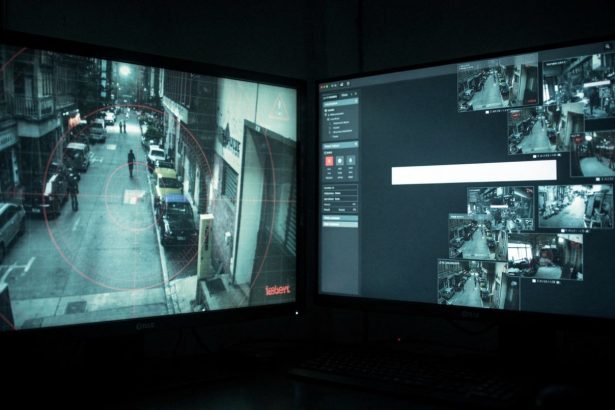
This matters because ICE already operates one of the most expansive facial recognition programs in U.S. law enforcement. The agency has access to hundreds of millions of photographs through driver’s license databases, passport records, and other government ID systems. It has used this capability to identify people at airports, border crossings, and in some cases, during routine traffic stops. But those deployments occur within certain boundaries—vendor contracts, congressional oversight (however limited), and public scrutiny.
Smart glasses change the equation. Wearable facial recognition technology collapses the distance between surveillance infrastructure and the officer on the street. Instead of running a photo through a database at a desk, an agent wearing ICE’s glasses could instantly identify individuals in real-world settings—at protests, in neighborhoods, at public events—with no intermediary step, no paper trail, and no easy way for the public or civil rights advocates to know it’s happening.
How Does ICE Plan to Deploy This Technology?
The DHS official and conference attendee who described the plans to 404 Media did not provide details about the glasses’ technical specifications, timeline, or budget. But the strategic intent is clear from the “supplement” language: ICE views this as an additive capability, not a replacement. The agency would maintain its existing facial recognition infrastructure while layering on a mobile, real-time component that operates outside traditional oversight channels.
• Federal agencies conducted facial recognition searches on hundreds of millions of photos as of 2023
• ICE used facial recognition to identify protesters at Black Lives Matter demonstrations in 2021
• State driver’s license databases were searched by ICE agents in 2019 to identify undocumented immigrants
The legal landscape enabling this move is sparse. There is no federal law explicitly prohibiting law enforcement from developing or deploying facial recognition smart glasses. The FBI and other agencies have used facial recognition for years with minimal statutory constraint. A 2023 Government Accountability Office report found that federal agencies had conducted facial recognition searches on hundreds of millions of photos, yet Congress has not passed comprehensive legislation governing the practice. State-level restrictions exist in some jurisdictions, but they do not bind federal immigration enforcement.
What Makes This Different from Existing Surveillance?
What makes ICE’s plan particularly significant is the agency’s track record with facial recognition. In 2021, the agency used facial recognition to identify protesters at a Black Lives Matter demonstration in Washington, D.C. In 2019, ICE agents used the technology to search state driver’s license databases to identify undocumented immigrants. These deployments occurred with minimal public awareness until reporting exposed them. Smart glasses would make such operations even harder to detect or challenge.
The glasses also represent a shift in how surveillance infrastructure is built and deployed. Rather than relying on commercial vendors like NEC or Clearview AI—companies whose practices have drawn regulatory scrutiny and lawsuits—ICE would control the entire pipeline: the hardware, the software, the database access, and the rules governing use. Internal agency guidelines are far less transparent than vendor contracts, and far easier to change without public notice.
• Analysis of law enforcement facial recognition technology reveals significant racial and gender bias in identification accuracy
• NIST studies demonstrate varying accuracy rates across demographic groups in face recognition software
• Federal agencies lack standardized evaluation protocols for facial recognition deployment
What Are the Implications for Public Privacy?
For the average person, the implications are concrete. If you live in a neighborhood with a high ICE presence, or attend public events in areas where immigration enforcement operates, you could be identified and tracked without your knowledge or consent. The glasses would work in daylight, in crowds, and at distance—conditions where traditional identification methods fail. There would be no notification, no warrant requirement (under current law), and no way to opt out.
The development also signals that ICE views facial recognition not as a specialized tool for specific cases, but as a foundational capability that should be integrated into routine field operations. Smart glasses technology represents the hardware manifestation of that philosophy.
Is There Any Legal Framework to Stop This?
Congress has proposed facial recognition restrictions multiple times, but none have passed into law. The Biden administration issued an executive order in 2023 directing federal agencies to establish safeguards, but executive orders can be reversed. As of April 2026, no binding legal framework prevents ICE from building or deploying these glasses.
The question now is whether the agency will proceed quietly, or whether the revelation itself will trigger legislative or judicial pushback. The answer may depend on how much public attention this development receives in the coming weeks.