

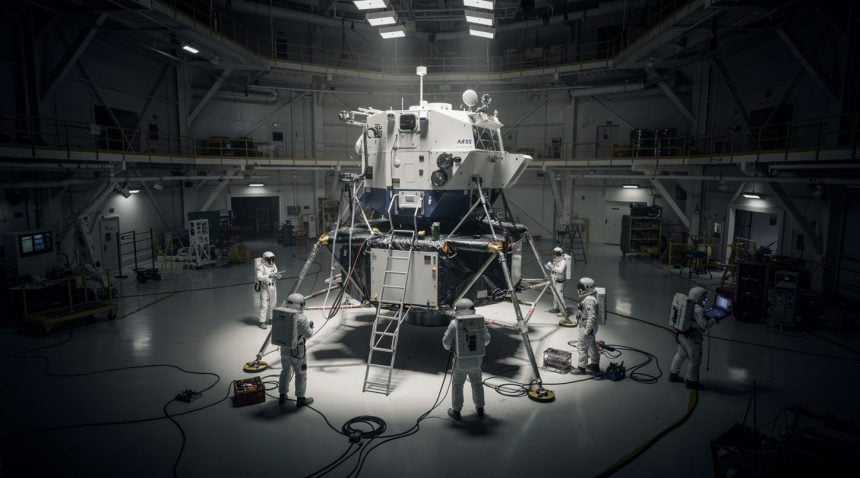
NASA has officially approved Blue Origin’s crew moon lander for astronaut training, moving the company’s lunar vehicle from engineering blueprint to operational reality. The space agency is now preparing to begin training with a prototype of Blue Origin’s lander, a milestone that transforms the 2028 moon landing from a target date into a concrete operational objective.
The approval marks a pivotal shift in how NASA approaches its return to lunar surface operations. Rather than relying solely on SpaceX’s Starship HLS (Human Landing System), NASA has now validated Blue Origin’s alternative lander as mission-ready for crew operations. This dual-vendor approach reduces dependency on a single contractor and introduces redundancy into one of the most ambitious human spaceflight programs of the decade.
- Training Approval: NASA has cleared Blue Origin’s lunar lander prototype for astronaut training, marking the transition from development to operational preparation.
- Dual-Vendor Strategy: The agency now has two certified crew landers, reducing reliance on SpaceX’s Starship HLS and creating competitive redundancy.
- Accelerated Timeline: The 2028 lunar landing target has shifted from aspirational planning to concrete operational commitment with active crew preparation.
Blue Origin’s lander design has been under development as part of NASA’s Human Landing System (HLS) program, which aims to deliver astronauts to the lunar surface as part of the broader Artemis mission architecture. The approval to begin astronaut training with a prototype signals that NASA engineers and safety officials have cleared the vehicle’s design, avionics, and operational procedures to a sufficient standard for human crews to familiarize themselves with its systems before actual lunar missions commence.
Why Is NASA Accelerating the 2028 Timeline?
The 2028 timeline is notably aggressive. It represents a compressed schedule compared to earlier Artemis planning, which had targeted the early 2030s for crewed lunar landings. By greenlighting training now, NASA is signaling confidence in Blue Origin’s development trajectory and its ability to deliver a flight-ready vehicle within the next two years. This acceleration also reflects broader political and budgetary pressures to demonstrate tangible progress in returning humans to the moon.
Astronaut training with the prototype will likely involve familiarization with the lander’s cockpit layout, control systems, emergency procedures, and crew interface. The training regimen mirrors principles found in privacy by design approaches, where safety and operational protocols are built into systems from the ground up rather than added as afterthoughts.
• Months of intensive preparation for selected Artemis astronauts
• High-fidelity simulators combined with physical prototype training
• Full spectrum coverage: nominal operations, system failures, emergency egress, and abort scenarios
How Does This Change the Commercial Space Landscape?
The approval also underscores NASA’s confidence in Blue Origin’s engineering team and manufacturing capabilities. The company, founded by Jeff Bezos, has been developing advanced propulsion systems and spacecraft for years through its New Shepard suborbital vehicle and its Blue Moon lunar cargo program. However, recent challenges with Blue Origin rocket missions highlight the technical complexities involved in scaling up space operations.
From a competitive standpoint, this approval reshapes the landscape of commercial lunar transportation. SpaceX’s Starship HLS has dominated headlines and funding discussions, but NASA’s validation of Blue Origin’s alternative means the agency is hedging its bets. Having two certified crew landers provides flexibility in scheduling, reduces launch cadence pressure on any single provider, and creates competitive incentives for both companies to maintain safety and performance standards.
What Does Astronaut Training Actually Involve?
The training program will also inform NASA’s broader Artemis strategy. Data collected from astronaut interactions with the Blue Origin prototype will feed back into mission planning, operational procedures, and contingency protocols. Any design refinements identified during training can be incorporated into the flight vehicle before crewed missions begin.
For the astronauts themselves, the 2028 timeline means intensive preparation is now underway. Those selected for early Artemis lunar missions will spend months becoming intimately familiar with Blue Origin’s lander systems, likely using high-fidelity simulators alongside the physical prototype. The training regimen will cover nominal operations, system failures, emergency egress, and abort scenarios—the full spectrum of what could occur during a lunar descent and ascent.
• Astronauts will learn descent engine operation, life support management, and precision landing procedures
• Training occurs in simulated scenarios where margins for error are minimal
• Emergency protocols account for Earth being hundreds of thousands of miles away during actual missions
Is the 2028 Target Actually Achievable?
The broader implication is that NASA is now operating under a concrete operational schedule. The 2028 date is no longer aspirational; it’s a commitment backed by hardware development, crew training, and institutional resources. This approval represents a public acknowledgment that the technical pathway to landing humans on the moon in the next two years is viable.
This shift toward operational readiness reflects broader trends in how government agencies approach strategic resource allocation and technological development timelines. The compressed schedule demonstrates confidence in private sector capabilities while acknowledging geopolitical pressures to maintain American leadership in space exploration.
Whether Blue Origin’s lander will actually fly a crewed mission in 2028 depends on successful completion of uncrewed test flights, final certification, and integration with the rest of the Artemis architecture. But with astronaut training now underway, NASA has moved from planning to execution. The next major milestone will come when the first uncrewed test flight of the lander occurs—a moment that will either validate this accelerated timeline or force a recalibration of expectations.