
A Czech synthesizer company just proved that the line between acoustic and digital instruments can be blurred so seamlessly that half a million dollars in crowdfunding will follow.
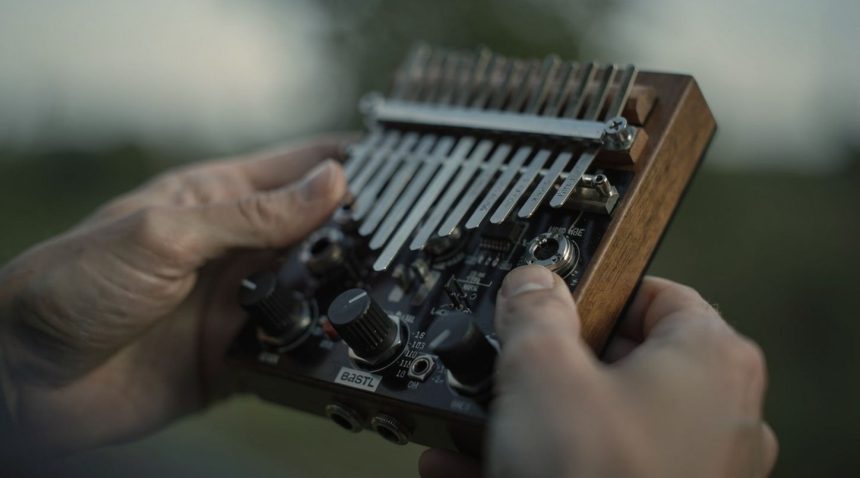
The Bastl Kalimba is exactly what its name suggests and almost nothing like it. Visually, it’s a thumb piano—that wooden percussion instrument with metal tines you pluck with your thumbs. Functionally, it’s a full synthesizer that hijacks the kalimba’s form factor as an interface. The tines don’t vibrate to produce sound. Instead, they’re touch and velocity-sensitive triggers wired to a synth engine built on physical modeling and FM synthesis. The result is an instrument that can sound like a traditional kalimba when you want it to, but can also generate pads, plucks, and textures that no acoustic thumb piano could ever produce.
- The Funding Success: Bastl’s hybrid kalimba-synthesizer raised over $700,000 on Kickstarter, proving demand for acoustic-digital fusion instruments.
- The Interface Innovation: Traditional kalimba tines become velocity-sensitive triggers that control synthesis parameters rather than producing direct sound.
- The Design Solution: By borrowing centuries-refined tactile feedback from acoustic instruments, the device solves digital music’s “uncanny valley of touch.”
The Kickstarter campaign has already raised over $700,000, a number that speaks to something deeper than novelty. Musicians and producers are genuinely excited about an instrument that refuses to be categorized neatly as either acoustic or electronic.
The internal architecture is where the real synthesis happens. Bastl included an internal microphone that captures the subtle acoustic resonance of the wooden body and the physical contact of your fingers on the tines—you can blend this organic layer into the digital signal for texture. But the heavy lifting comes from the synth engine itself. The tines trigger sound synthesis rather than produce it directly, which means every pluck is both a musical gesture and a data input. Velocity matters. Position on the tine matters. The timing between fingers matters. All of these become parameters that shape what the synth generates.
How Does Physical Touch Translate to Digital Control?
The instrument ships with a library of sounds that range from traditional kalimba tones to lush synthesizer pads, and the built-in effects suite includes spatial processing—delay and reverb—as well as distortion. This is not a gimmick product pretending to be a synth. It’s a fully featured digital instrument wearing acoustic clothing.
What makes the Bastl Kalimba particularly interesting from a digital design perspective is how it solves a persistent problem in electronic music: the uncanny valley of touch. Research in digital musical interfaces has long documented how digital instruments struggle with the tactile feedback loop that acoustic instruments provide naturally. A piano key gives you resistance. A guitar string gives you tension. A kalimba’s tines give you a specific physical sensation. By using the kalimba’s familiar form factor as the interface, Bastl didn’t invent new tactile feedback—it borrowed it from an instrument that’s been refined for centuries. The synthesizer then takes what your hands are doing and translates it into sound in ways the acoustic version never could.
• Digital musical instruments often fail to provide satisfying tactile feedback compared to acoustic counterparts
• Musicians report stronger emotional connection to instruments with physical resistance and texture
• Hybrid designs that combine acoustic touch with digital sound processing show higher user satisfaction
Why Are Musicians Abandoning the Analog vs Digital Debate?
The crowdfunding success suggests musicians are hungry for instruments that don’t force a false choice between “authentic” and “digital.” The Bastl Kalimba sits in a space where both qualities coexist. You’re playing something that feels like a traditional instrument but behaves like a modern synthesizer. Your muscle memory from playing a real kalimba could theoretically transfer, but the sonic possibilities explode exponentially.
This kind of instrument design also reflects a broader shift in how we think about the boundary between analog and digital tools. For decades, the narrative was zero-sum: synthesizers replaced acoustic instruments, digital audio replaced tape, software replaced hardware. But the most interesting recent innovations—hardware synthesizers with analog circuits, digital instruments with acoustic elements, hybrid workflows—suggest that musicians are less interested in replacement and more interested in combination.
This mirrors trends we see in other technology sectors where users increasingly reject binary choices. Just as digital minimalism represents a middle path between complete digital rejection and uncritical adoption, hybrid instruments offer musicians a way to access both acoustic authenticity and digital flexibility without compromise.
What Does $700,000 in Crowdfunding Really Mean?
The Bastl Kalimba’s $700,000 Kickstarter haul is partly about the novelty of the form factor, sure. But it’s also validation that there’s real demand for instruments that blur categorical lines. The tines are velocity-sensitive triggers, not strings. The body is a resonator and a housing, not the primary sound source. The synth engine is the real voice, but the acoustic elements give it character. Everything is both things at once.
$700K+ – Crowdfunding raised for hybrid kalimba-synthesizer
Centuries – Time kalimba design has been refined for optimal touch
Both – Acoustic feel and digital flexibility in one instrument
According to research on musical instrument design, successful digital instruments often succeed by preserving familiar physical interactions while expanding sonic capabilities. The Bastl Kalimba follows this pattern precisely—it keeps the thumb-plucking gesture that kalimba players know instinctively but routes that gesture through synthesis algorithms that can generate sounds no acoustic instrument could produce.
For anyone who’s ever felt constrained by choosing between the warmth of acoustic instruments and the flexibility of digital synthesis, the Bastl Kalimba represents a kind of détente. It’s a reminder that sometimes the most innovative tools don’t force you to pick a side—they let you play both.