

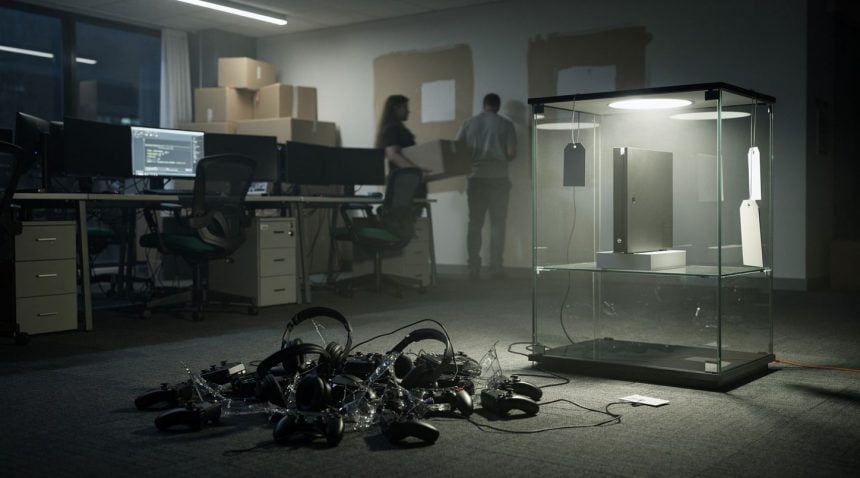
On June 10th, Asha Sharma sent a memo to Xbox staff announcing an “Xbox reset” — and the gaming industry has been reeling ever since. The newly appointed CEO and Matt Booty, the newly promoted chief content officer, laid bare the numbers: a 3 percent “accountability margin,” massively higher component prices for consoles due to memory and storage shortages, and what they called an “over extended” studio system that had to shrink.
What followed was a bloodbath. By late June, reports confirmed that Microsoft was preparing to close at least five studios, cancel games like Blade, and shutter beloved franchises including Hellblade and the team behind it, Ninja Theory. Console prices spiked another $100 or more. Game Pass lost new Call of Duty titles. Xbox, once positioned as gaming’s most player-friendly platform, is now unrecognizable.
- The Accountability Gap: Internal documents reveal a 3 percent “accountability margin” — a figure so thin it made the entire studio expansion model economically indefensible.
- The Hardware Shock: Component shortages drove Xbox Series X prices up by $100 or more, pushing the console into premium territory at the exact moment PlayStation held its pricing steady.
- The Studio Toll: At least five studios face closure, with teams behind Hellblade, Dishonored, and Deathloop among those dismantled — representing decades of accumulated creative and institutional knowledge.
- The Model Collapse: Game Pass, once Xbox’s defining competitive advantage, lost new Call of Duty titles as Sharma’s reset exposed the subscription model’s unsustainable unit economics at scale.
The stakes are enormous — not just for the 10,000-plus employees affected, but for every gamer who bought an Xbox Series X expecting a stable, thriving ecosystem. Sharma’s “reset” is reshaping the entire business model of Microsoft’s gaming division, and it’s happening in real time. The component crisis hitting Xbox is not isolated: Apple’s RAM crisis and Valve’s Steam Machine pricing collapse reveal the same supply chain fracture running through the entire hardware industry in 2026.
How Did Xbox’s Studio Empire Collapse So Quickly?
Sharma took over as Xbox CEO after Phil Spencer stepped back into a different role at Microsoft. Her mandate was clear: fix the bleeding. The division had been hemorrhaging money on acquisitions that didn’t pan out, on studios that couldn’t ship hits, and on a Game Pass strategy that looked generous but was crushing margins. The memory and storage shortage that hit the industry in 2025 made component costs for the Xbox Series X and Series S balloon unexpectedly. Suddenly, the math didn’t work.
The July 6th layoffs were the hammer blow. Studio closures weren’t abstract corporate restructuring — they meant real people losing jobs at Ninja Theory, Compulsion Games, and others. Arkane Studios, the team that made Dishonored and Deathloop, faced potential shutdown as Microsoft weighed canceling Blade. IO Interactive, developer of the James Bond game 007 First Light, laid off staff even as it claimed its next franchise project would continue. The human cost was staggering.
• Research published in the ACM Digital Library documents that since 2023, the video game industry has faced a severe workforce reduction marked by widespread layoffs and studio closures — a structural contraction that predates and contextualizes Microsoft’s current crisis.
• The same analysis draws a direct line from the 1983 Atari Shock to modern consolidation patterns, suggesting that platform overcorrections following rapid expansion are a recurring industry failure mode, not an anomaly.
• Studio closures carry compounding costs beyond headcount: institutional knowledge, franchise equity, and mid-development project value are effectively written off when teams dissolve.
Why Did Console Prices Spike at the Worst Possible Moment?
The studio closures were only half the story. Console prices jumped another $100 or more — a massive increase that pushed the Xbox Series X into premium territory just as PlayStation held the line on pricing. That price hike, driven by the component shortage and Sharma’s push to restore profitability, created a brutal choice for consumers: pay significantly more or buy a competitor’s hardware.
The component crisis driving these increases is an industry-wide phenomenon. Microsoft’s situation mirrors what Microsoft’s own AI spending crisis revealed earlier in 2026 — a company simultaneously over-committed on multiple expensive fronts, forced to make painful trade-offs when capital constraints tighten. The difference is that gaming consumers feel hardware price increases immediately and personally in a way that enterprise software restructuring does not.
What Does the “Play Anywhere” Reversal Actually Signal?
Simultaneously, Sharma made a series of strategic pivots that contradicted years of Xbox messaging. Game Pass Ultimate saw price cuts, but new Call of Duty games were yanked from the service. Two major exclusives — Gears of War: E-Day and Clockwork Revolution — were locked to Xbox consoles only, reversing the “play anywhere” philosophy that had defined the brand. The company even rebranded “Xbox” to “XBOX” in all caps, a visual signal that something fundamental was changing.
What’s driving all this? The source documents and reporting reveal a division in crisis. Microsoft’s gaming business had expanded too fast, acquired too many studios, and committed to a Game Pass model that looked visionary but was economically unsustainable at scale. The memory shortage was the final straw — it made the hardware unprofitable. Sharma inherited a machine that was burning cash, and she chose the scorched-earth approach: cut studios, cut games, cut costs, and restore margins, even if it meant alienating players and employees.
5+ studios facing closure in the current restructuring wave
$100+ increase in Xbox Series X pricing driven by component shortages
3% “accountability margin” cited internally as the trigger for the entire reset
10,000+ employees affected across Microsoft’s gaming division
Is Microsoft Preparing to Exit the Console Business Entirely?
The ripple effects are still unfolding. Hideo Kojima’s game OD will reportedly still be published by Xbox, but the broader picture is one of contraction. Matthew Ball, a game industry analyst, was hired to lead strategy — a signal that Xbox is rethinking its entire approach from first principles. The company is even exploring “radically different” console business models, suggesting that the traditional hardware-and-software stack may not survive this reset intact.
Microsoft hasn’t ruled out spinning off Xbox entirely, a nuclear option that would signal complete loss of faith in the division’s future under its current structure. The competitive pressure from Nintendo’s continued mobile experimentation — including Nintendo’s Pictonico launch — illustrates how rival platforms are pursuing growth strategies while Xbox contracts, further compressing the window in which Microsoft can stabilize its position.
What Does This Mean for Players Who Already Bought In?
For consumers, this matters in concrete ways. If you own an Xbox Series X, your console just became more expensive to replace. The games you expected to play on Game Pass are disappearing. The studios you loved — the teams that made Hellblade, Dishonored, and Deathloop — are being dismantled or shuttered. The promise of Xbox as the player-first platform has evaporated.
Sharma’s “reset” is a bet that Microsoft can shrink its way to profitability, that fewer studios and higher prices will stabilize the division long enough for new hits to emerge. But it’s a gamble with enormous downside risk. Every studio closure is a loss of institutional knowledge, creative talent, and franchise potential. Every price hike pushes players toward PlayStation or Nintendo. Every game cancellation is a broken promise to fans who invested in the ecosystem.
• The hiring of Matthew Ball — whose research has consistently argued that gaming’s traditional platform economics are structurally broken — suggests Sharma’s team believes incremental fixes are insufficient and that the division’s entire revenue architecture requires redesign.
• The simultaneous reversal of “play anywhere” exclusivity and Game Pass breadth indicates a strategic retreat to hardware lock-in as the primary monetization lever, a model that requires premium pricing to function — precisely the dynamic now alienating the consumer base Xbox spent a decade cultivating.
• Industry analysts tracking the post-2023 consolidation wave note that studios closed during financial resets rarely reopen; the creative infrastructure being dismantled now represents a multi-year rebuilding cost that Sharma’s margin calculations may not fully account for.
The question now is whether this reset actually works. Will the cost cuts and studio closures free up resources for a new generation of hits? Will the higher console prices stabilize margins without cratering sales? Will Game Pass survive as a service without the blockbuster releases that justified its value? These are not rhetorical questions — they are the operational tests that will determine whether Xbox exists in its current form by 2027.
Sharma has 100 days to prove the reset is working. The next major announcement is expected in September, when Microsoft will likely reveal which games are in active development and which studios have survived the cuts. Until then, Xbox remains in limbo — a once-dominant platform in freefall, betting everything on a CEO’s ability to rebuild from rubble.


