
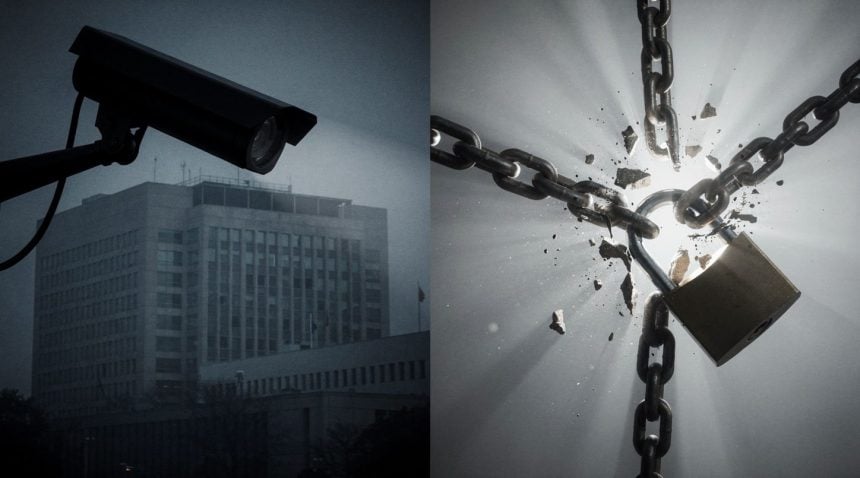
In June 2026, a law that had quietly authorized the warrantless surveillance of millions of Americans’ private communications simply expired—and Congress did not renew it.
Section 702, the statute that has underpinned domestic spying operations for over three decades, lapsed this month in what privacy advocates are calling a major victory. The law was sold to the public as a tool for monitoring foreign targets, but in practice it became the legal machinery that allowed U.S. intelligence agencies to intercept and read the private conversations of American citizens without a warrant. For years, the revelations kept coming: misuse after misuse, reauthorization after reauthorization, with Congress repeatedly choosing to extend the law despite mounting evidence of abuse. Until now.
- 35 Years of Warrantless Access: Section 702 operated for over three decades, allowing intelligence agencies to collect Americans’ private communications without individualized warrants or suspicion.
- Scale Without Consent: The law functioned at the level of internet infrastructure itself, sweeping up emails, messages, and video calls from Americans who had no knowledge they were being monitored.
- A Prospective Victory Only: The expiration stops future warrantless collection but provides no mechanism for deletion of data already held in government databases — meaning the surveillance record remains intact.
The mechanics of Section 702 were deceptively simple. Intelligence agencies could target foreigners abroad and, in the process, sweep up communications from Americans who happened to be talking to those targets — or whose messages passed through the same digital infrastructure. No warrant required. No individualized suspicion. Just a legal gray zone where millions of private conversations could be collected, stored, and searched by government officials.
What made this surveillance particularly insidious was its scale and invisibility. Unlike a wiretap on a specific phone line, Section 702 operated at the level of internet infrastructure itself. Agencies could access the private messages, emails, and video calls of Americans without those Americans ever knowing they were being monitored. The law created what amounted to a permanent dragnet, justified by the foreign intelligence exception to the Fourth Amendment. As analysis from the Jackson School of International Studies at the University of Washington has documented, the statute’s broad framing created persistent tension between national security imperatives and constitutional privacy protections — a tension that was never meaningfully resolved through legislative reform.
How Did Section 702 Become a Domestic Surveillance Tool?
The parallels to Cambridge Analytica’s data-harvesting operation are structural and worth examining. Cambridge Analytica didn’t need a warrant to collect millions of Facebook users’ psychological profiles — it just needed access to the platform’s data and a legal framework that didn’t prohibit it. Section 702 operated on the same principle: if the law doesn’t explicitly forbid it, and if you can frame it as serving national security, then mass collection of private communications becomes routine. Both systems relied on the absence of meaningful consent from the people being profiled. Both treated scale as a feature, not a bug. Both operated for years before the public fully understood what was happening. The legacy of Cambridge Analytica demonstrated precisely how legal ambiguity, combined with institutional appetite for data, can normalize surveillance at a population level.
The difference is that Cambridge Analytica was eventually exposed, prosecuted in the court of public opinion, and dismantled. Section 702, by contrast, was repeatedly reauthorized — often with minimal congressional debate — even as evidence of systematic misuse accumulated. The intelligence community’s argument was always the same: the program is essential, the abuses are isolated, and the alternative is unacceptable risk. That argument held for 35 years.
• Section 702 was first enacted in 2008 and reauthorized multiple times, operating for over 35 years in various forms under the broader FISA framework
• The law permitted “backdoor searches” of collected data — querying databases of intercepted communications using American citizens’ identifiers without a warrant
• In January 2025, a federal court ruled for the first time that backdoor searches of Section 702 data are unconstitutional, a landmark finding that preceded the law’s expiration
What Did the Courts Say Before the Law Expired?
The legal challenge to Section 702 did not begin with its expiration. In January 2025, in a significant ruling that received less public attention than it deserved, a federal court found that the backdoor searches of Section 702-collected data were unconstitutional. The Electronic Frontier Foundation documented this ruling as the first time a court had directly confronted the constitutional status of the practice — a practice that had been ongoing for years under the assumption that it occupied a legal gray zone rather than a prohibited one. That judicial finding shifted the political calculus around reauthorization and contributed to the conditions that allowed the law to lapse.
The expiration of Section 702 marks a rupture in that pattern. After decades of reauthorization — often rushed through Congress with minimal debate — the law simply lapsed. The Electronic Frontier Foundation, which has tracked Section 702’s abuses for years, described the expiration as a victory for privacy advocates over the intelligence establishment. That victory did not come easily. It came after years of revelations about how the law was actually being used, after civil liberties organizations challenged its constitutionality, and after a shifting political landscape made blanket reauthorization politically untenable. The organized resistance that emerged after Cambridge Analytica helped build the public literacy around surveillance systems that made this kind of political pressure possible.
• The Electronic Frontier Foundation has consistently argued that Section 702’s “incidental collection” framework was a legal fiction — in practice, the program was designed to capture American communications at scale, not as a byproduct
• EFF’s published analysis frames Section 702 as a structural violation of privacy rights affecting millions of people, not an edge case of occasional overreach
• The core legal problem identified by civil liberties advocates: once data is collected and stored, the absence of a warrant requirement for querying it means the Fourth Amendment protection effectively disappears at the point of use
Is the Surveillance Infrastructure Actually Dismantled?
What happens next remains uncertain. The expiration creates a legal vacuum. Intelligence agencies can no longer operate under Section 702’s authority, but Congress could theoretically pass a new law with similar powers. The question now is whether the momentum that allowed Section 702 to lapse will hold, or whether a new surveillance statute will emerge with different language but the same practical effect. The history of surveillance reform offers little comfort here: the USA PATRIOT Act’s most controversial provisions were repeatedly extended, modified, and rebranded rather than eliminated. The same institutional pressures that sustained Section 702 for 35 years have not disappeared.
Understanding how government agencies build and sustain data infrastructure beyond any single statute requires examining the broader ecosystem of contractors and analytical platforms. Palantir’s role in government data surveillance illustrates how the analytical capacity built around programs like Section 702 persists even when the legal authority for collection changes — the tools, the databases, and the institutional relationships remain.
For millions of Americans whose communications were collected under Section 702, the expiration offers no retroactive remedy. The data already collected remains in government databases. There is no mechanism for deletion, no apology, no acknowledgment of the scope of the surveillance that occurred. The expiration is a prospective victory — it stops future warrantless collection, but it does not undo the past.
What Comes After the Expiration?
The broader implication is this: the legal infrastructure that enabled mass surveillance of Americans without a warrant has, for the first time in 35 years, been allowed to expire. Whether that expiration becomes permanent depends on what Congress does next and whether the privacy advocates who blocked reauthorization can sustain political pressure as the intelligence community inevitably pushes for a replacement. The pattern established by whistleblowers and civil liberties advocates — of exposing specific abuses, building public understanding, and converting that understanding into political pressure — is the same pattern that ultimately brought Section 702 to this point. The role of whistleblowers in exposing surveillance systems remains as relevant now as it was when Christopher Wylie came forward about Cambridge Analytica’s operations.
The Electronic Frontier Foundation has published detailed analysis of what Section 702’s expiration means and what to watch for in coming months. The fight over warrantless surveillance is not over — it has simply entered a new phase, one in which the burden falls on the intelligence community to justify any replacement authority rather than on privacy advocates to block an existing one. That shift in burden, modest as it may seem, represents the most significant structural change in American surveillance law in a generation.